

A Historic El Niño Is Coming. Your Area Drains Are the First Line of Defense.
On September 21, Governor Newsom declared a statewide state of emergency to get California ready for this winter's El Niño. NOAA's Climate Prediction Center gives better than a 90% chance of a very strong event this fall and winter. For October through December, NOAA puts "a 75% chance of a historic event," stronger than any El Niño on record since 1950.
The state's advice to homeowners is short: know your flood risk, clear your drains and gutters, sign up for alerts, and make a plan. Cal OES Director Caroline Thomas Jacobs said it plainly: "We are not waiting for this season's storms to be on our doorstep." You shouldn't either.
El Niño doesn't promise a wet winter. It stacks the odds. And in Rancho Cucamonga, Alta Loma, Upland, and Ontario, the water that damages homes usually isn't a river. It's rain that lands on your roof and patio and has nowhere to go because the area drain is packed with dirt.
What Your Area Drain Does (and Why It's Probably Clogged)
An area drain is the small grate in your patio, side yard, planter, or driveway low spot. Under it, a buried pipe carries rainwater out to the curb, the street, or a sump. When it works, you never think about it. We've written before about why Alta Loma homeowners need to clean their backyard area drains. This winter's forecast makes it urgent for the whole valley.
The problem is timing. After a long dry stretch, these lines fill up quietly:
- Dirt and silt wash in with every sprinkler cycle and settle in the low spots of the pipe.
- Leaves and debris blow in with fall Santa Ana winds and pack down over the grate.
- Mulch, bark, and landscape rock creep in from planters.
- Roots find the pipe joints and grow into a mat.
- Crushed or sagging pipe from settling soil or a car parked over the line holds water and catches everything.
- Blocked curb outlets at the street stop the whole run even if the pipe is clean.
None of that shows up in a sunny September. It shows up during the first real storm, when a line that trickled fine under a sprinkler can't move a downpour.
How a Clogged Area Drain Floods a House
Water on a patio has two places to go: down the drain or toward your house. When the drain is clogged, it picks the house. Here's how it usually plays out:
- Rain comes off the roof and downspouts faster than the plugged drain can take it.
- Water pools on the patio and starts climbing.
- It reaches the sliding patio door, where the slab is often poured close to the door threshold.
- The door's track has small weep holes built to let water drain out. Once the water outside is as high as the track, those holes let it in.
- The track fills, water runs under the door, and it soaks into carpet, baseboards, and flooring.
Your Sliding Door Wasn't Built to Hold Back Water
Most sliding patio doors aren't built to hold back rising water. They're designed to shed rain running down their face. Once water pools against the threshold, it gets under the door long before the glass is in danger. But if the water keeps rising in a serious flood, or a mudflow pushes rocks and debris onto the patio, the pressure and impact can crack or break the glass too.
The same pooled water can also sit against stucco and the edge of the slab, where it finds its way into walls and under flooring. The fix isn't a better door. It's a drain that moves water away before it ever gets that high.
Signs Your Area Drain Is Already Clogged
- Water stands on the patio for hours after rain or a sprinkler cycle.
- The grate is full of dirt, grass, or leaves, or you can't see the pipe below it.
- Water bubbles up out of the drain during a storm instead of going down.
- Nothing comes out of the curb outlet at the street while it's raining.
- You've found mud lines on the stucco or a muddy track inside the sliding door.
- There's a soft or sunken spot in the yard along the drain line, which can mean a broken pipe.
Quick test: Run a garden hose into the drain for five minutes and check the curb outlet. If the water backs up at the grate or never shows up at the street, the line needs attention before the rain does it for you.
What a Professional Area Drain Clearing Looks Like
A hose and a hand snake can pull a clump off the top. They won't clear a line packed with silt and roots. Here's what our drain cleaning crew does instead:
- Camera inspection. We run a camera down the line to find exactly where it's blocked and whether the pipe is cracked, crushed, or full of roots.
- Hydro jetting. Our hydro jetter puts out up to 4,000 PSI at 12 gallons per minute, with hot water when we need it. It scours the pipe walls and flushes the dirt out to the street instead of just poking a hole through it. It handles lines from 2 to 12 inches, which covers residential area drains.
- Curb outlet check. We confirm water actually reaches the street, not just the next low spot in the pipe.
- Repair or reroute if needed. If the camera shows a broken or sagging section, we'll show you the footage and talk through fixing it or adding a channel drain where water keeps collecting.
The best time to call is now. Once the first big storm hits, every plumber in the Inland Empire gets the same phone call at the same time. If water is already coming in, our 24/7 emergency plumbing line is open.
What You Can Do This Weekend
Some prep doesn't need a plumber:
- Pull the grates and scoop them out. Clear whatever's sitting on top and just inside the inlet.
- Clean gutters and downspouts. Make sure downspouts either tie into the drain or empty well away from the house.
- Check the curb outlet. Clear leaves and dirt from the opening at the street.
- Keep the patio clear. Don't store rugs, cushions, or bags of soil over or next to a drain.
- Skip the chemical drain cleaner. It does nothing for dirt and roots in an outdoor line.
- Have sandbags ready for the door that's taken water before.
If the hose test fails after all that, the clog is deeper than you can reach.
Get Your Drains Cleared Before the First Storm
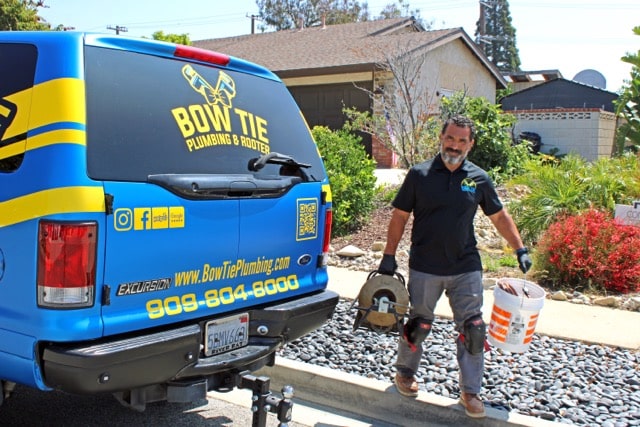
Bow Tie Plumbing & Rooter is a family-owned plumber based in Rancho Cucamonga, serving Alta Loma, Upland, Ontario, and the rest of the Inland Empire. We'll camera your area drains, hydro jet what needs it, and show you exactly what we found.
Call 909-804-8000 or book online. Before you schedule, check our Hydro Jetting Special and our lowest-price drain cleaning special.
Check them every fall before the rainy season. For a full hydro jetting, we generally recommend every 18 to 24 months, sooner if you have trees near the line or a yard that sends a lot of dirt into the drain.
Yes. Test the pump before the season by filling the pit with a hose. A clean line doesn't help if the pump won't kick on.
It depends on your policy, so call your agent before the storms, not after. As CBS Los Angeles reported, standard homeowners policies don't cover flood damage. LA County Public Works' Kerjon Lee told them, "we really strongly advise residents to invest in flood insurance" if you're in a high-risk area.
You can try on a short line with a light clog. A rental snake usually punches through a plug and leaves the silt behind, so it clogs again at the first heavy rain. Here's how hydro jetting compares to snaking.